IT teams are surrounded by signals and informaiton, but understanding what is actually happening can still take too long.
A service starts producing more errors. Another application slows down. A configuration changed shortly before the problem appeared. The information exists, but it is scattered across logs, alerts, events and different systems.
This gap between detecting a problem and understanding it is becoming more important as IT environments grow more complex.
The cost of getting it wrong is also significant. Uptime Institute’s 2026 outage analysis found that 57% of organizations said their most recent major outage cost more than $100'000, while 20% said it cost more than $1 million.
At the same time, detection alone is not solving the problem. SANS' Detection and Response Report found that 90% of organizations already rely on automated detection tools, yet 73% still identify false positives as a major detection challenge. Meanwhile, 76% plan to increase their use of AI and machine learning for detection and response.
The numbers suggest that the problem is not a lack of signals but making sense of the ones that are already there.
From detecting an issue to understanding the story
Consider a service that suddenly starts producing authentication errors. A few minutes later, latency increases in two applications that depend on it. Shortly before that, a configuration was changed.
A monitoring system may detect all three events correctly but the difficult part is understanding that they belong together.
An engineer still has to compare timestamps, search through logs, check dependencies and determine which event came first. In a complex environment, this investigation can take longer than the initial detection itself.
This is where AI can add real value. Rather than producing another alert, AI can help build the context around what has already been detected. It can bring together related events, highlight what changed before the issue started, and help explain which services may have been affected.
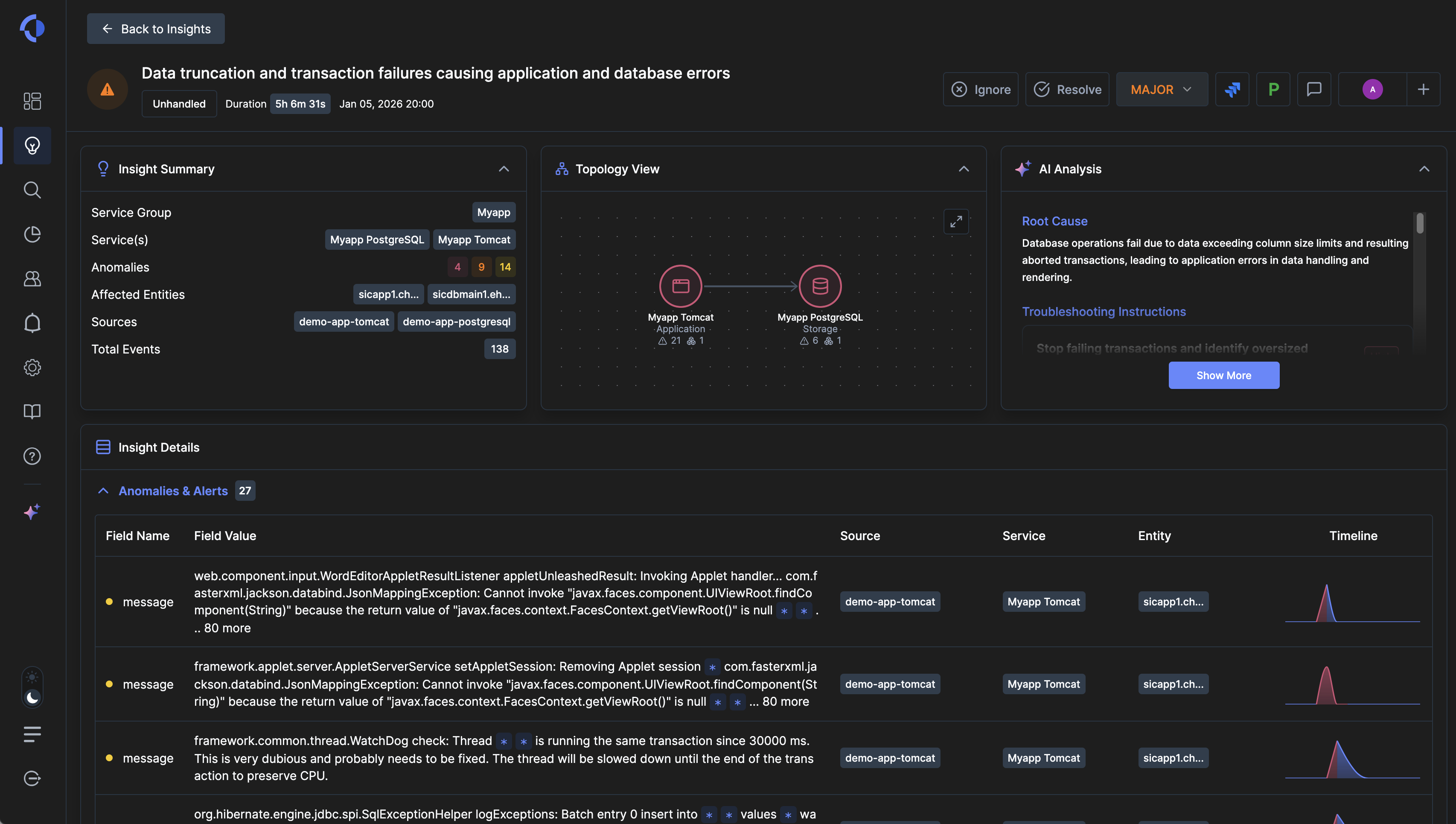
That is also the idea behind Modu, Logmind’s AI investigation agent. Modu works with the operational context available inside Logmind. Instead of looking at a single log message in isolation, it can help teams investigate Insights and understand the events surrounding a problem.
This changes the role of AI significantly. A general AI model can explain what an authentication error usually means, but an AI system with operational context can go much further.
Context matters more than another alert
This is especially important because false positives remain a major problem.
According to SANS, 60% of organizations encounter false positives frequently or very frequently, while only 13% have reached full automation in their detection and response processes.
Those numbers suggest that the next step for AI should not be simply more automation but also a better judgment. Before an AI system can support action, it needs to recognize meaningful changes, connect related events and give operators enough context to decide what to do next with confidence.
From AI assistant to operational intelligence
This also changes what we should expect from an AI agent.
The most useful AI agents may not be the one making the most decisions on its own, but it may be the one that helps engineers make better decisions faster.
By combining logs, anomalies, service relationships, recent changes, and historical patterns, AI can build a clearer picture of an incident and help teams focus on what matters. Instead of spending valuable time searching across systems and manually connecting signals, engineers can move more quickly toward identifying the likely cause, assessing the impact, and deciding on the right response.
Considering that more than half of organizations report six-figure costs from major outages, shortening that path from detection to decision can have a very practical impact.
This is where Modu can evolve beyond a traditional AI assistant. Its value is not simply in explaining what happened but in helping operators understand what matters, where to investigate next and what information should guide their response.
In practice, that means engineers spend less effort piecing together the incident and can respond and resolve issues faster.