Retail IT has evolved far beyond managing store infrastructure and point-of-sale systems. Today’s retail operations depend on highly interconnected ecosystems that include e-commerce platforms, payment gateways, ERP systems, inventory management, warehouse operations, customer loyalty applications, cloud services, and third-party APIs - all expected to operate seamlessly in real time.
The customer experience now depends directly on IT performance.
When systems slow down or fail, the impact is immediate. A delayed payment authorization, inaccurate inventory update, or outage during peak shopping hours can quickly affect revenue, customer trust, and brand reputation. According to recent industry research, unplanned downtime now costs Global 2000 organizations nearly $600 billion annually.
For retail organizations, the financial impact can escalate even faster during major sales events. Gartner estimates cited across multiple industry reports place the average downtime cost at roughly $5,600 per minute, while retail e-commerce outages during peak shopping periods can result in losses between $1 million and $2 million per hour. (Source: 1GLOBAL)
At the same time, retail environments are becoming significantly more complex. Global retail organizations are accelerating investments in AI, automation, and digital operations at unprecedented speed. NVIDIA’s 2026 State of AI in Retail report found that 91% of retailers are already using or evaluating AI technologies, while 90% plan to increase AI investments this year.
Every new digital service, API integration, cloud workloads, and AI-driven process adds another layer of operational dependency that IT teams must monitor and manage in real time.
The Visibility Problem in Modern Retail Operations
Retail organizations generate enormous volumes of operational data every day. Logs, alerts, metrics, and events flow continuously from stores, e-commerce applications, cloud infrastructure, warehouse systems, payment services, and connected devices.
The problem is that most of this data exists in silos.
Infrastructure teams monitor servers and networks. Application teams focus on APIs and digital services. Security teams manage separate event streams. Operations teams often rely on multiple dashboards that provide isolated views rather than a complete operational picture.
This fragmentation creates major visibility gaps during incidents.
A payment issue may initially appear as application latency. Inventory synchronization problems may surface first through customer complaints. A network disruption affecting stores may simultaneously impact checkout systems, loyalty services, and online order processing.
By the time teams manually correlate logs and alerts across systems, customer-facing services may already be affected.
According to Cisco research, 47% of organizations report that customers detect outages before IT teams do, while 81% of technology leaders say downtime directly leads to customer loss.
The operational burden is also increasing internally. Recent studies show that 75% of IT teams experienced outages caused by missed alerts, with alert fatigue and tool sprawl identified as major contributing factors. (Source: Computer Weekly)
As retail infrastructures continue expanding across hybrid and multi-cloud environments, traditional operational processes are becoming increasingly difficult to scale.
Why Traditional Monitoring Falls Short
Most retailers already collect plenty of operational data; the real challenge is transforming it into actionable intelligence.
Traditional monitoring platforms were designed to detect isolated events using predefined rules and thresholds. In highly distributed retail environments, this often results in overwhelming alert volumes with very little operational context.
A single infrastructure issue can trigger hundreds or even thousands of alerts across applications, databases, APIs, cloud services, and networking layers. Instead of accelerating incident response, excessive alerts create operational noise and slow troubleshooting efforts.
The impact becomes especially visible during major shopping events where infrastructure demand spikes dramatically.
Retail organizations cannot afford long investigation cycles when online checkout systems, payment services, and customer-facing applications are under pressure. Customers expect seamless digital experiences regardless of traffic volumes, backend complexity, or infrastructure dependencies.
The challenge is no longer simply monitoring infrastructure health.
Retail IT teams now need:
- Visibility into dependencies between systems
- Faster root cause identification
- Real-time anomaly detection
- Reduced operational noise
- Proactive incident management across hybrid environments
This is where AIOps is becoming critical.
How AIOps Helps Retail IT Teams Respond Faster
AIOps (Artificial Intelligence for IT Operations) helps organizations manage operational complexity by applying machine learning and analytics to logs, metrics, alerts, and events.
Instead of analyzing alerts individually, AIOps platforms identify patterns, correlate related incidents, and surface the operational issues that truly matter.
For retail IT teams, this changes how incidents are detected and resolved.
Rather than switching between disconnected dashboards, teams gain centralized visibility across stores, cloud infrastructure, ERP systems, e-commerce applications, payment platforms, and third-party services. Operational data from multiple sources can be analyzed together in real time, allowing teams to understand how issues propagate across interconnected systems.
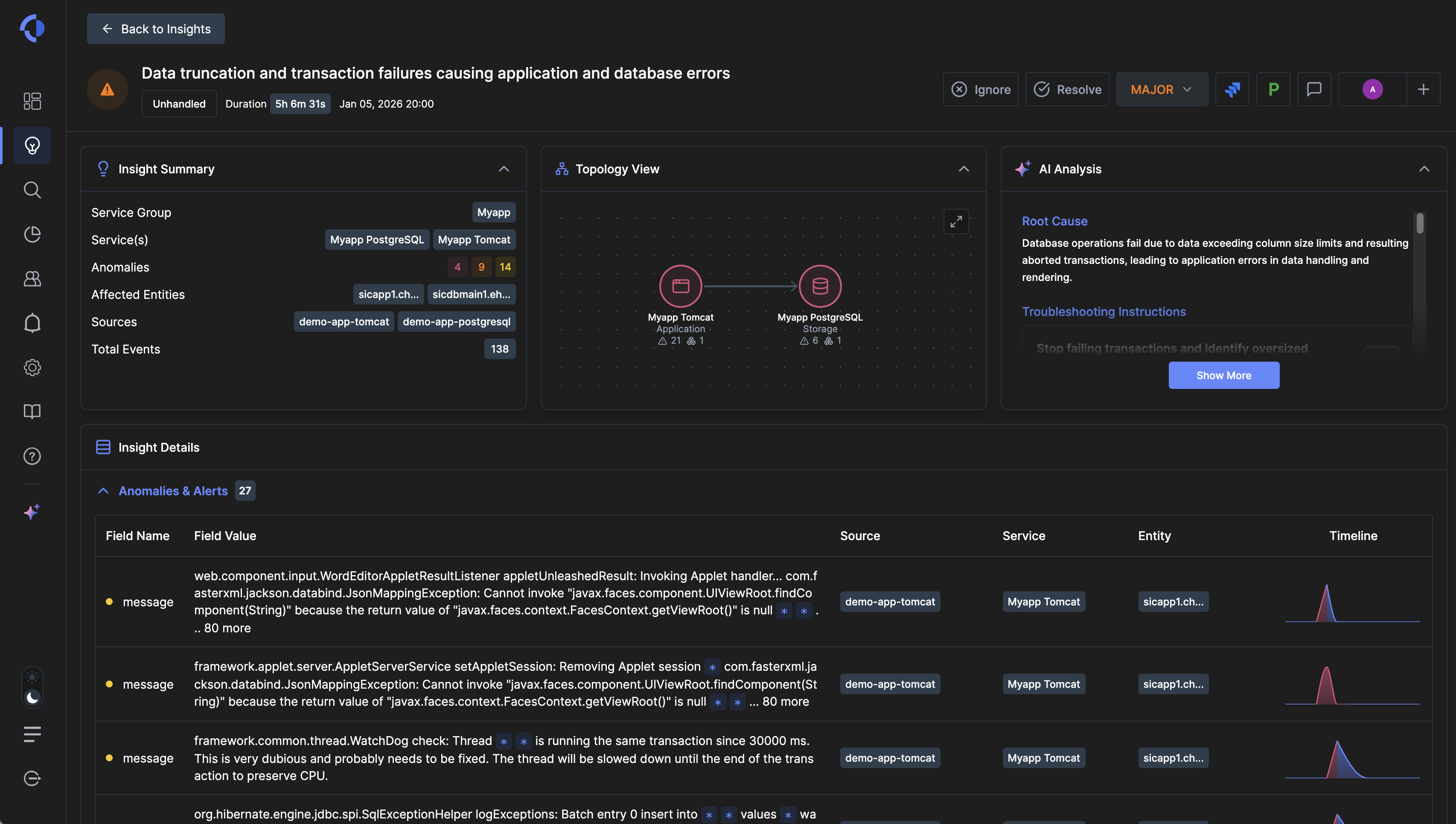
For example, if online checkout failures begin increasing during a promotional campaign, AIOps can automatically correlate API latency, payment gateway behavior, database performance, and infrastructure anomalies to identify the likely source of the issue much faster than manual investigation processes.
This significantly reduces operational noise while accelerating root cause analysis.
AIOps platforms also help retailers move from reactive troubleshooting toward proactive operations. Modern observability platforms are increasingly capable of predicting service degradation before outages occur. In retail environments, this may include:
- Gradual increases in payment transaction failures
- Slower inventory synchronization between systems
- Rising API response times
- Store connectivity instability
- Unusual spikes in checkout latency
These early indicators are often difficult to detect manually because they may appear insignificant in isolation. AIOps platforms continuously analyze operational patterns to surface anomalies earlier and provide contextual insights around potential business impact.
Breaking Down Operational Silos
One of the biggest operational benefits of AIOps is the ability to reduce silos between infrastructure, applications, cloud operations, and business services.
Modern retail incidents rarely stay confined to a single domain.
A failed customer transaction may involve payment services, APIs, databases, ERP synchronization, cloud infrastructure, and network connectivity simultaneously. Without unified operational visibility, multiple teams may investigate the same incident independently while resolution times continue increasing.
AIOps platforms help create a shared operational context by correlating data across systems and presenting incidents as connected operational events rather than isolated alerts.
This improves collaboration between teams while helping organizations prioritize incidents based on customer and business impact instead of raw alert volume alone.
Organizations adopting unified observability and AIOps strategies are already seeing measurable operational improvements. For retailers operating across both physical and digital channels, this level of operational intelligence is becoming increasingly important to maintaining service reliability at scale.
Moving from Reactive Monitoring to Operational Intelligence
Retail environments will continue becoming more distributed, data-intensive, and dependent on real-time digital services.
As complexity grows, manual operational processes and traditional monitoring approaches become harder to scale effectively. IT teams need platforms capable of transforming fragmented operational data into actionable intelligence quickly enough to prevent customer impact.
This is why AIOps is becoming a foundational capability for modern retail operations.
With Logmind, retail IT teams can centralize logs and operational data, reduce alert fatigue, accelerate incident correlation, and proactively identify anomalies across complex hybrid environments.