Proactive IT operations to improve continuity of care
Hospital IT environments operate under strict availability and reliability requirements. Clinical applications, electronic health records, imaging systems, laboratory platforms, and underlying infrastructure must function continuously to support continuity of care. In the case for hospitals, even short disruptions can impact clinical workflows, delay patient treatment, and increase operational risk.
Despite this, many healthcare companies still rely on traditional, reactive monitoring processes that struggle to provide early visibility into issues across increasingly complex environments.
The challenge: Growing complexity and IT risk in healthcare
Healthcare companies operate highly interconnected digital ecosystems combining on‑premise infrastructure, virtualised platforms, hybrid cloud services, and a growing number of clinical applications. As this complexity increases, so does operational risk, particularly when dependencies between systems and services are not clearly visible.
Research published in the Journal of Medical Internet Research showed that unplanned downtime of clinical IT systems is real, and generates workflow disruptions, delays in documentation, and increased operational stress for clinical staff. This underlines the importance of proactive detection and rapid incident response.
The main challenges for healthcare IT teams are clear:
- Fragmented observability: Hospitals collect large volumes of operational data (infra and app logs, network telemetry, alerts), but this data is siloed across multiple platforms and teams.
- Rule-based alerting: Static rules and thresholds for alerting, manually configured and maintained, detect issues too late, generate noise, miss atypical failures, and contribute to alert fatigue and slow response.
- Lack of issue correlation and contextualisation: Gartner notes that organisations struggle less with data availability than with correlating signals across domains to understand system behaviour and incident impact. Without correlation, early warning signs remain isolated and difficult to interpret.
- Manual troubleshooting: Incident investigation relies on human-led, tool-by-tool analysis, extending resolution times and increasing strain on IT teams.
This translates into slow detection and resolution times, system downtime and user-facing incidents, in the context of hospital directly affecting the care delivery. Studies on electronic health record downtime have shown that even short outages require fallback procedures, increase cognitive load for clinicians, and introduce operational risk. For this reason, healthcare organisations place particular emphasis on resilience, governance, and predictability.
The solution: Unified, proactive IT intelligence and automation
Adding more monitoring tools or alerts does not solve the underlying issue. What healthcare IT teams need is proactive, unified intelligence: understanding which signals matter, how systems and services are connected, and what to do to solve the issues before it impact the users. Logs, alerts, and system events form the foundation of this operational awareness, and Logmind helps to make sense of it.
"With Logmind, we transformed our traditional reactive resolution process into predictive automation – and the intuitive platform made it very easy”
Head of IT Operations, Healthcare company
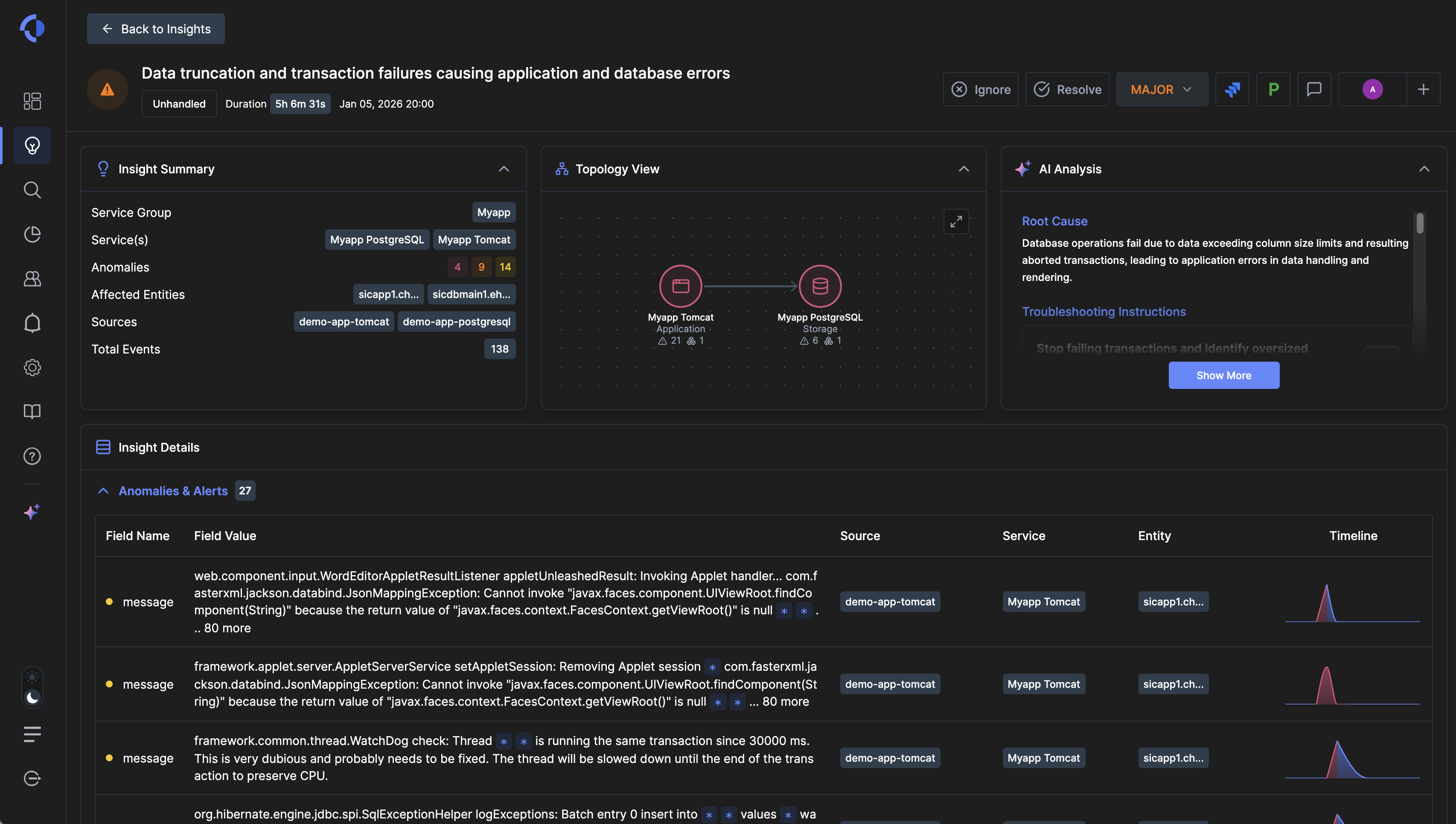
Logmind's platform mission is to turn those millions of logs and thousands of alerts into prioritized, actionable insights and specific solution recommendation. It gives you the automated intelligence layer you need, consolidating and correlating all the signals of your IT environment, from infra and network to applications.
The advanced machine learning engine removes the need to manually configure complex rule sets and static alert logic. Teams can feed any log, alert and event data sources, regardless of its format, directly into the platform using standard protocols or log forwarders, to gain immediate end-to-end visibility.
By automatically correlating, prioritizing and diagnosing these signals in a real‑time topology, IT teams can detect emerging issues earlier across systems and get a clear understanding of how to address them.
This helps healthcare and life science organizations cut downtime and limit user-facing incidents, minimize detection and resolution time, boost IT team productivity and cut monitoring costs and complexity.